

Photo Credit: Getty Images
When The Pitt first arrived on HBO Max nearly a year ago, it did so without the usual advantages of a built in franchise or a cast packed with marquee names. Aside from the lingering debate with the Michael Crichton estate over its perceived resemblance to ER, the series stood on its own as a grounded and restrained medical drama. What it lacked in flash, it made up for in precision, empathy, and a deep respect for character driven storytelling. That quiet confidence has since paid off. Season Two returns with the show firmly established as one of television’s most acclaimed dramas, bolstered by its recent Emmy win for outstanding drama series and several additional awards.
Despite this elevated status, The Pitt wastes no time reminding viewers that acclaim changes little inside the walls of Pittsburgh Trauma Medical Center. Under the steady guidance of star and executive producer Noah Wyle, creator R Scott Gemmill, and producing director John Wells, the series resumes its near real time structure. Each season unfolds over the course of a single shift, and Season Two drops us back into the emergency room with no interest in reintroductions or spectacle. For the doctors, nurses, and support staff, it is simply another exhausting day on the job.
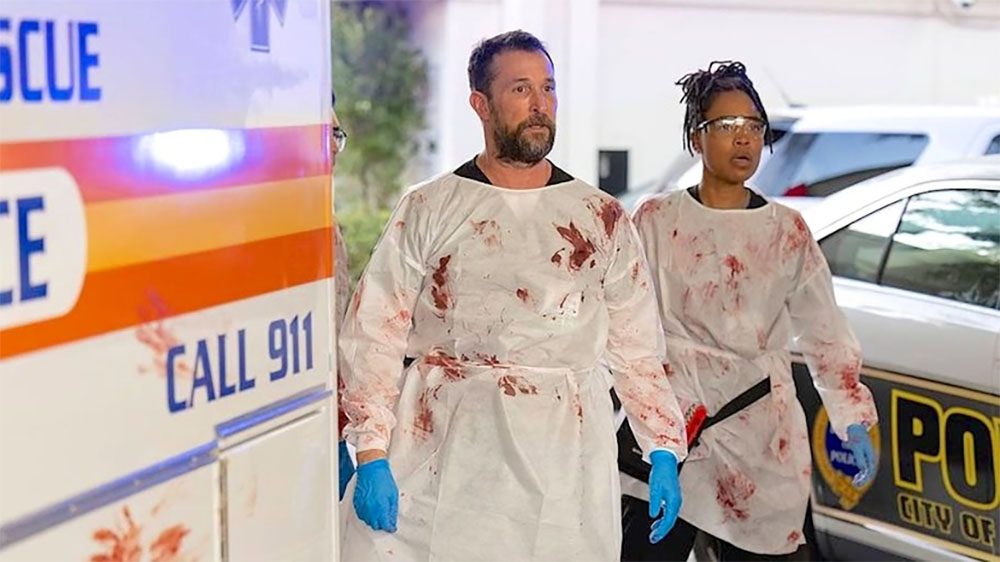
The changes that do exist are subtle and deeply human. Wyle’s attending physician Michael Robby Rabinovich arrives for his Fourth of July shift on a motorcycle, a new habit that earns him teasing from colleagues and quietly signals lingering emotional unrest following the mass shooting that defined last season’s climax. A memorial plaque now hangs in the lobby, a silent acknowledgment that trauma does not simply fade with time. This shift is also meant to be Robby’s last before a sabbatical, which naturally ensures that nothing will go according to plan.
Around him, the rest of the staff face turning points of their own. Dr Frank Langdon returns from a forced absence after confronting a prescription drug addiction, his relationship with Robby tense and unresolved. Dr Samira Mohan weighs her future as her residency ends, while Dennis Whitaker steps into a teaching role after once being the unsure student himself. New medical students arrive with confidence and sharp edges, and new professionals expand the scope of the hospital, including a case manager navigating insurance systems and a psychiatrist tending to mental health crises in an emergency setting.
What continues to define The Pitt is its refusal to separate its characters from the patients they serve. Season Two maintains the show’s strong social conscience, addressing issues that naturally surface in an emergency room that serves a broad cross section of society. The series explores immigration enforcement, fat bias in medicine, terminal illness, homelessness, artificial intelligence in healthcare, and accessibility for unhearing patients. These themes are handled with earnestness rather than performative messaging, woven into patient stories that feel lived in and urgent. Moments of humor still surface through absurd injuries and awkward mishaps, but they never undercut the show’s core seriousness.
While the season occasionally strains to replicate the intensity of last year’s mass casualty event, The Pitt is at its best in quieter moments. Performances subtly evolve to reflect the cumulative toll of the work. Robby is shorter tempered, Dana more guarded, and Trinity Santos carries herself with earned confidence rather than defensive bravado. The series trusts its audience to notice these shifts without spelling them out, reinforcing the bond between viewer and show.
Season Two proves that The Pitt did not need reinvention to justify its return. Its strength lies in continuity, compassion, and craft. Coming back to it feels less like revisiting a hit show and more like returning to capable hands that understand the weight of the world and the people tasked with holding it together.