

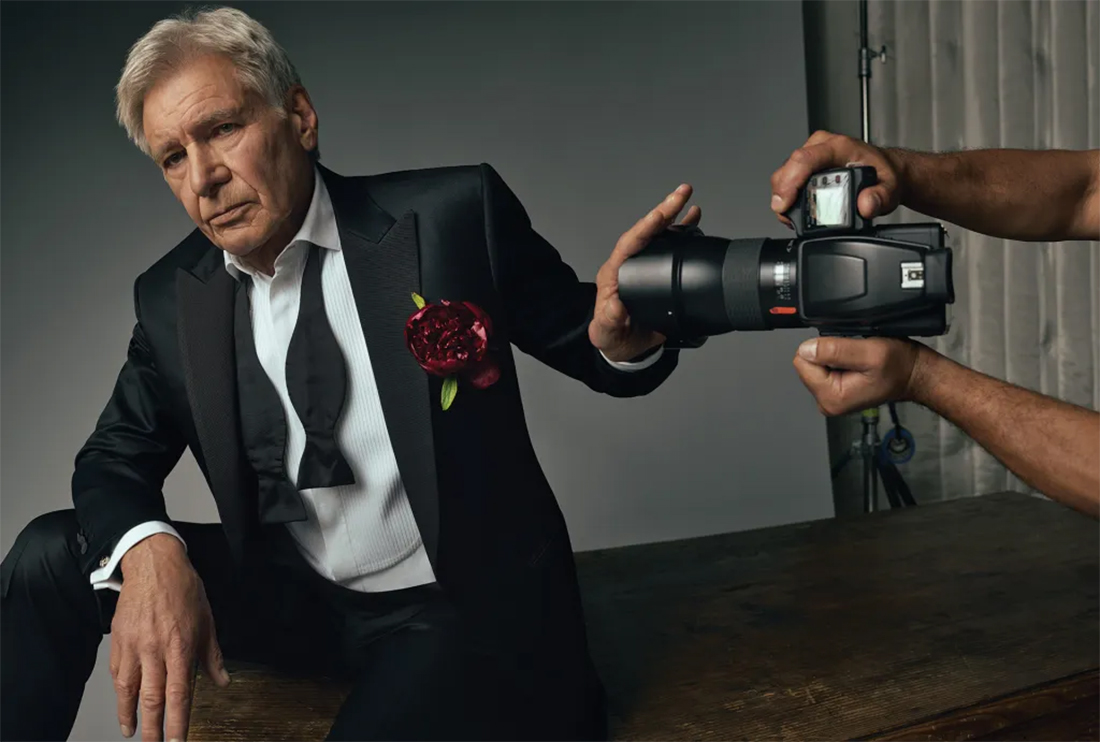
Photo Credit: Getty Images
Harrison Ford, at 83, remains a commanding figure—still magnetic in front of the camera, still sharp with his dry wit, and still uninterested in resting on decades of legendary performances. With his first-ever Emmy nomination for his role in Apple TV+’s Shrinking, Ford finds himself entering a new chapter—not as a legacy star coasting on nostalgia, but as an actor actively shaping compelling new characters.
In Shrinking, Ford plays Dr. Paul Rhoades, a therapist grappling with Parkinson’s, a role that has shown a looser, more vulnerable side of the actor. His co-star Jason Segel describes Ford’s comedic instincts with awe, recalling a standout episode where Ford’s character crashes a party while high on edibles: “He got a giant laugh from the crew and whispered to me, ‘I knew I was fucking funny.’”
The c”medy is subtle, but the work is serious. Ford credits the format of streaming TV for giving him the space to develop characters more deeply than film allows. “We get more time to develop a character over a season than one normally does in a film,” he says. But even with all his experience, Ford’s process remains grounded: “I say the words, do the work, rinse and repeat.”
Ford’s approach to acting is additive—brick by brick, building a performance from lived experience. “You’ve got to know what your job is here—am I the onion or am I the tomato?” he quips. His respect for craft is evident in his insistence on honoring the reality of Paul’s illness. The inclusion of Michael J. Fox in Season 3 has added weight to that commitment. “Michael gives me both a physical representation of the disease and the belief that Paul could be adequate to the challenge,” Ford says. “Parkinson’s is not funny. I want to get it right.”
Though Ford claims he never aspired beyond character acting, his resume—spanning Star Wars, Indiana Jones, Blade Runner, Witness, and more—tells a different story. Still, his humility runs deep. “I don’t think there’s anything competitive about creativity,” he says of his Emmy nomination. “If you like it, you like it. If you don’t, look at something else.”
Reflecting on decades in Hollywood, Ford remains grounded in values forged long before box office records. “I never expected to be anything more than somebody who made a living as an actor,” he says.
And yet, he can’t help but speak to broader truths beyond the screen. “The rich get richer. The poor get poorer. That ain’t right,” he states, cutting through with the same directness that has defined both his characters and his real-life persona.
Whether delivering dry one-liners, improvising iconic scenes, or calling out societal injustice, Ford shows no signs of fading quietly into the background. He’s still here, still working, and—by all accounts—still having a damn good time.






