

Photo Credit: Getty Images
Sky watchers are being treated to a spectacular celestial event this week as August's full Sturgeon Moon coincides with a deep partial lunar eclipse, creating what astronomers describe as an almost total eclipse.
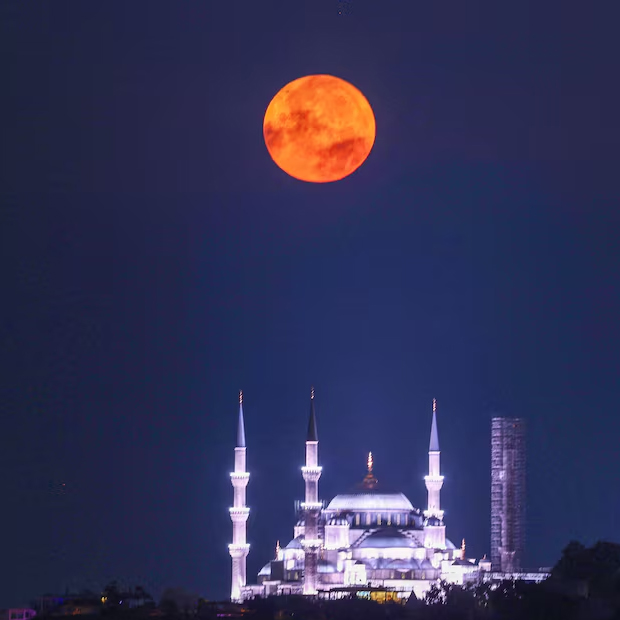 The lunar event will take place overnight on Thursday into Friday, with Earth's shadow expected to cover about 96 percent of the Moon's surface at the peak. Although the event will not qualify as a total lunar eclipse because a small portion of the Moon will remain outside Earth's darkest shadow, its appearance is expected to be striking.
A lunar eclipse occurs when Earth moves directly between the Sun and the Moon, causing Earth's shadow to fall across the lunar surface. The darkest part of that shadow is known as the umbra. When the entire Moon enters the umbra, a total lunar eclipse occurs. This week's event will instead leave a small section illuminated by direct sunlight.
The partial eclipse is scheduled to begin at approximately 10:34 p.m. Eastern Time on Thursday, with maximum eclipse occurring shortly after midnight on Friday. The full Moon will reach its peak at around 12:18 a.m. Eastern Time. Observers across large parts of North and South America will have an opportunity to see much or all of the eclipse, depending on their location.
Unlike a total lunar eclipse, which can turn the Moon a dramatic reddish orange, this event is unlikely to produce the same deep "blood Moon" appearance. Because a small portion of the lunar surface will remain directly illuminated by the Sun, the overall colour effect will be less intense.
Astronomers say viewers do not need special equipment to safely watch a lunar eclipse. Unlike solar eclipses, lunar eclipses can be observed with the naked eye. However, finding an area away from bright artificial lights can significantly improve visibility.
The event also provides an opportunity to appreciate the cultural history attached to the full Moon. The name Sturgeon Moon is traditionally associated with Algonquin speaking peoples and other Indigenous communities around the Great Lakes, where lake sturgeon were historically abundant during this period.
Different Indigenous communities have used other names for the August full Moon, including the Black Cherries Moon and Green Corn Moon.
The August eclipse is one of several lunar events occurring in 2026. The year's remaining full Moons include the Harvest Moon in September, the Hunter's Moon in October, the Beaver Moon in November and the Cold Moon in December. November and December will also feature supermoons.
For sky watchers, however, the immediate attraction is the Sturgeon Moon. With nearly the entire lunar surface slipping into Earth's shadow, Thursday night promises a memorable display above the night sky.