

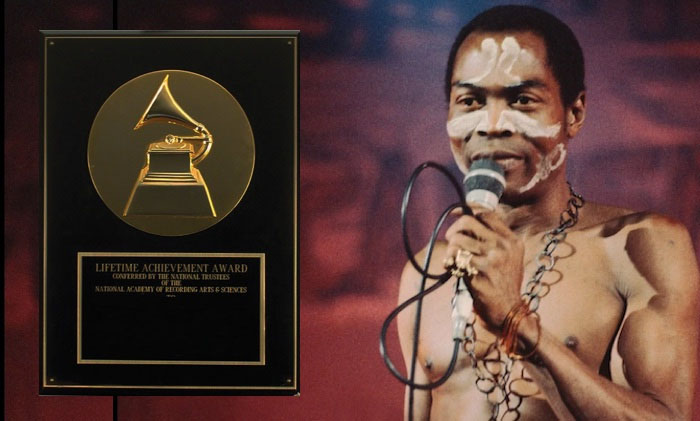
Photo Credit; Getty Images
The late Nigerian music legend Fela Anikulapo Kuti has been officially recognised by the global music industry as he becomes the first African to receive the Grammys Lifetime Achievement Award. The honour will be given posthumously almost three decades after his death in 1997 at the age of 58. For many fans who have long regarded him as the king of Afrobeat this moment represents overdue global acknowledgement of an artist whose influence reshaped music culture and political expression far beyond Africa.
Fela Kuti’s son and fellow musician Seun Kuti described the recognition as a moment of balance in his father’s long story. Speaking to the BBC he said Fela had lived in the hearts of the people for decades and that the Grammys acknowledgement felt like a double victory. Long time friend and former manager Rikki Stein also welcomed the award calling it better late than never and noting that African music had not historically received strong attention from major global institutions.
The award comes at a time when African music has gained increasing international visibility. Following the worldwide success of Afrobeats a genre inspired by Fela’s original Afrobeat sound the Grammys introduced the Best African Performance category in 2024. Nigerian superstar Burna Boy has also received a nomination in the Best Global Music Album category. Despite these recent developments Fela Kuti remains the first African to be honoured with a Lifetime Achievement Award which was first introduced in 1963.
Fela Kuti was far more than a musician. He was a cultural theorist political agitator and the undisputed architect of Afrobeat which later influenced modern Afrobeats. Working closely with drummer Tony Allen he fused West African rhythms with jazz funk highlife extended improvisation and politically charged lyrics. Over a career spanning roughly three decades he released more than 50 albums and used music as a tool for resistance protest and social critique.
His outspoken opposition to corruption injustice and military rule in Nigeria brought him into direct conflict with authorities. In 1977 following the release of his album Zombie his Lagos compound known as Kalakuta Republic was raided burned and its residents attacked. His mother Funmilayo Ransome Kuti later died from injuries sustained during the assault. Rather than retreat Fela responded with music turning grief into protest through songs like Coffin for Head of State.
Fela’s ideology was shaped by pan Africanism anti imperialism and African rooted socialism. His political awareness was deeply influenced by his mother as well as by activist Sandra Izsadore during his time in the United States. He even dropped the name Ransome from his birth name due to its Western origins. In 1978 he married 27 women in a public ceremony reflecting the communal vision of Kalakuta Republic.
On stage Fela was commanding and unmistakable leading bands of more than 20 musicians during legendary performances at the Afrika Shrine in Lagos. His shows blurred the line between concert political rally and spiritual gathering. His visual identity was shaped by artist Lemi Ghariokwu who designed many of his album covers and described the award as a mark of immortality.
Today Fela Kuti’s music continues to resonate across Africa and the diaspora influencing artists such as Burna Boy Kendrick Lamar and Idris Elba. His son Seun Kuti who now leads the band Egypt 80 reflects on his father not as a myth but as a disciplined leader musician and parent who believed music was a mission rather than entertainment. The Grammys Lifetime Achievement Award stands as global recognition of a legacy rooted in courage resistance and cultural truth.






