

Photo Credit: Getty Images
Colombia’s audiovisual industry is experiencing its biggest surge yet, with filmmakers and major studios around the world flocking to the country for its growing production opportunities and attractive incentives. The nation’s 2025 Audiovisual Investment Certificate, known as CINA, was fully allocated by mid-September, marking an unprecedented milestone that highlights Colombia’s rising profile as a global filmmaking hub.
Introduced in 2012 alongside the Colombia Film Fund, the CINA incentive offers a 35 percent transferable tax credit, which has drawn in numerous high-profile productions over the years. Streaming giant Netflix has been a major player in this growth, investing heavily in series and films shot in Colombia. Among its most ambitious undertakings is the adaptation of Nobel Laureate Gabriel Garcia Marquez’s One Hundred Years of Solitude, the largest and most expensive Latin American production in the company’s history. After the first season’s critical success last year, the second and final installment is now in post-production and set to premiere next year.
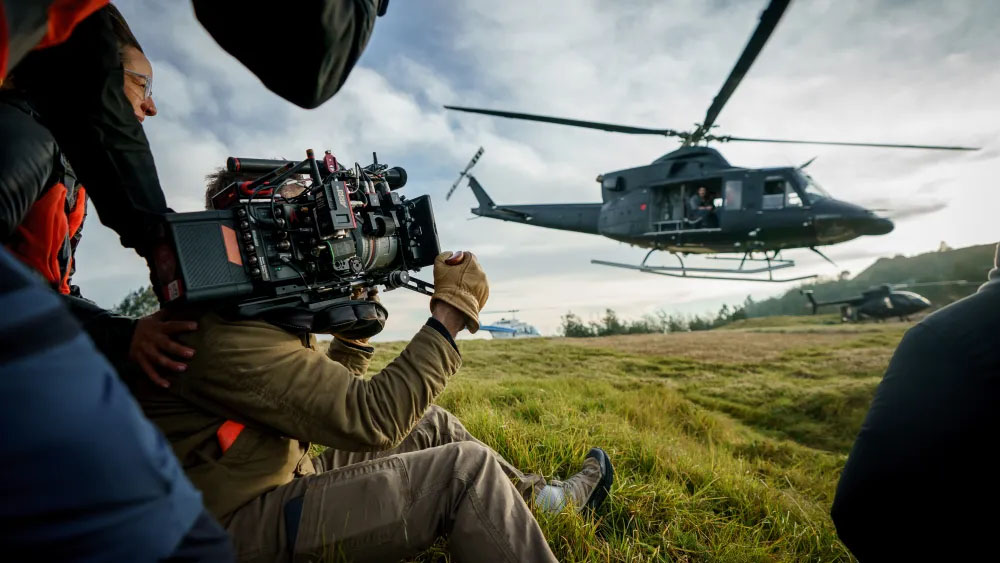
Zack Snyder, celebrated for visually ambitious films like 300, Man of Steel and Justice League, recently wrapped filming in Colombia on his deeply personal project The Last Photograph. Shot across Bogota, Chingaza National Park and the Amazon, Snyder worked with a lean crew that included a local team assembled by production services company Jaguar Bite. The director operated his own camera, averaging an impressive forty setups a day, while relying almost entirely on Colombian rentals for equipment.
“It’s a more intimate movie in scope and scale but it doesn’t really matter how big it is, it’s still the same amount of work,” Snyder said, praising the professionalism and skill of the Colombian crew. His experience, shared through behind the scenes photos on his new Instagram account, drew more than 250,000 followers in just a few weeks.
Kiefer Sutherland echoed that sentiment after starring in Justin Chadwick’s Sierra Madre, another major production serviced by Jaguar Bite. “The main takeaway for me was how extraordinary I found the talent. The actors that I had the opportunity to work with from Colombia were truly exceptional,” he said.
Colombian Film Commissioner Silvia Echeverri notes that studios are now recognizing the country’s growing infrastructure and technical capacity to handle large-scale international projects that were once only possible in Mexico or Brazil. Local companies such as Jaguar Bite and Secuoya Latin America have elevated their standards through collaborations with high-caliber filmmakers, while major studios like RCN, Caracol and TIS Studios are opening their soundstages to more outside productions.
According to Proimágenes, Colombia’s audiovisual production has generated remarkable economic benefits, including over 570,000 hotel nights and 30,000 airline tickets, strengthening tourism and services across the nation. Incentivized projects now span twenty-four departments and one hundred fifty-three municipalities, illustrating the widespread impact of the industry’s growth.
With 32 new projects approved under the 2025 CINA incentive and an estimated investment of 188 million dollars, Colombia’s film and television industry has attracted a total of 861 million dollars in accumulated investment since the program began, creating more than 130,000 direct jobs. As streaming services and global filmmakers continue to discover its potential, Colombia’s ascent as a premier production destination shows no signs of slowing.






