

Photo Credit; Getty Images
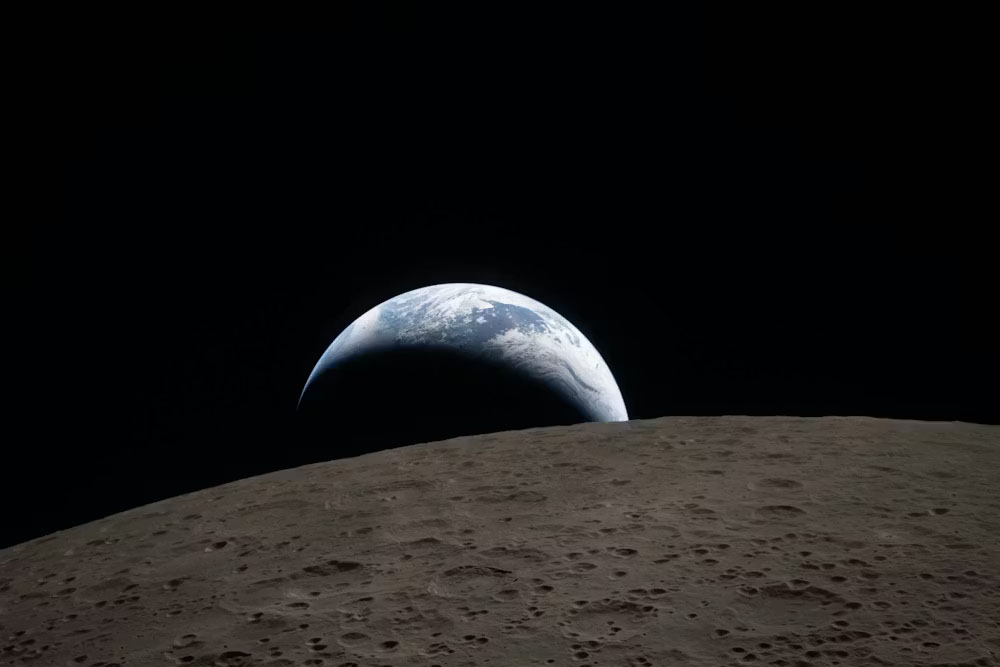
In 1968, as the crew of Apollo 8 orbited the Moon, they witnessed something no human had ever seen before. Commander Frank Borman described the lunar surface as lifeless and colourless, a stark mix of grey black and white shaped by craters and volcanic remains. Then, during their fourth orbit, everything changed. Rising above the barren horizon was Earth, glowing with colour against the darkness of space. Astronaut Bill Anders captured the moment in what became known as the Earthrise photograph, an image that would go on to shape how humanity sees its home.
The Earthrise image quickly became one of the most reproduced photographs in history. It showed Earth not as an endless expanse beneath our feet but as a small fragile sphere suspended in space. That shift in perspective helped spark the environmental movement and contributed to the creation of Earth Day in 1970. For many, it was the first time they truly understood the planet’s vulnerability.
Nearly six decades later, astronauts on the Artemis II mission have captured a new image called Earthset. Taken during a flyby of the Moon in April 2026, the photograph shows Earth dipping below the lunar horizon. While similar in composition to Earthrise, the meaning behind Earthset is shaped by everything that has happened in the years between the two images.
Unlike the accidental nature of the original photograph, this time the moment was anticipated. Nasa had made clear that they intended to capture a modern version of Earthrise, aware of the emotional and historical weight such an image carries. The Artemis crew succeeded, producing a photograph that again invites people to reflect on the planet from a distance.
Although 58 years is a short period in geological terms, scientists say the changes on Earth during that time have been significant. Atmospheric carbon dioxide levels have risen sharply, and global temperatures have increased by at least one degree Celsius. Human activity has reshaped landscapes through urban expansion, deforestation and the transformation of natural environments into agricultural land. One striking example is the Aral Sea, which has shrunk dramatically since the 1960s.
Some of these changes are visible even from space. Experts point to Antarctica as a key area of difference between the two images. The Antarctic Peninsula is one of the fastest warming regions on Earth, and tens of thousands of square kilometres of ice shelf have been lost since the time of Earthrise. Across the globe, the cryosphere has been affected, with reductions in sea ice and shifts in seasonal snow patterns.
Despite these changes, the Earth still appears beautiful from afar. That contrast between appearance and reality is part of what gives both Earthrise and Earthset their power. In 1968, pollution and environmental damage were already serious problems, even if they were less visible from space. Smog filled cities and rivers were heavily polluted, yet the image of a pristine planet inspired people to act.
Today, Earthset carries a similar message but in a more urgent context. Modern satellites continuously monitor the planet, providing detailed data about climate and environmental change. Still, images taken by humans have a unique emotional impact. They are framed with intention and perspective, reminding viewers that this small blue world is the only home humanity has.
Frank Borman once reflected that the crew had travelled all the way to the Moon only to find themselves most captivated by Earth. That insight remains just as relevant today. Earthset, like Earthrise before it, is not just a photograph. It is a reminder of both the beauty of our planet and the responsibility to protect it.