

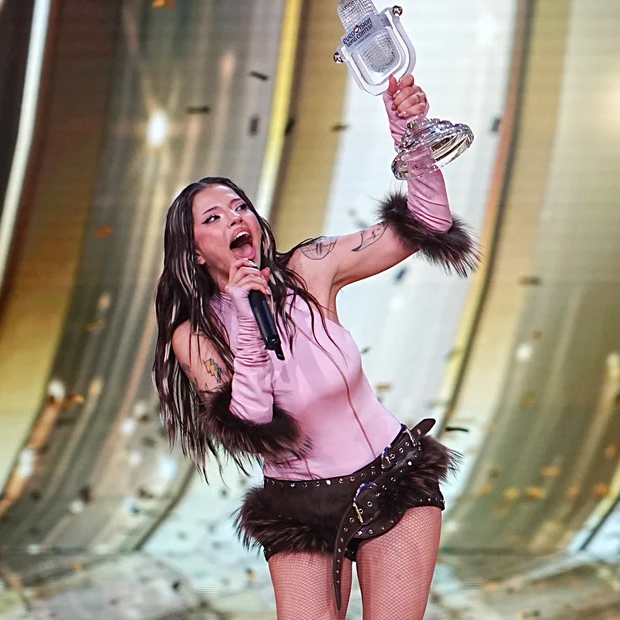
Photo Credit:Getty Images
Bulgaria made history after winning the 70th edition of the Eurovision Song Contest held in Vienna, Austria. Bulgarian singer Dara emerged victorious with her song “Banagaranga,” earning a total of 516 points and securing the country’s first ever Eurovision win in the competition’s long history.
The grand finale took place at the Wiener Stadthalle in Vienna and marked the 70th anniversary of Eurovision, one of the world’s most watched and longest running international music competitions. This year’s contest carried the theme “United by Music” and featured performances from countries across Europe and beyond. Austria hosted the event following Switzerland’s victory in 2025.
Israel’s Noam Bettan finished in second place with the song “Michelle,” collecting 343 points. Bettan received strong support from viewers at home, especially during the public voting stage where Israel earned 220 audience points. Romania’s Alexandra Căpitănescu came third with her song “Choke Me,” scoring 296 points and delivering one of the standout performances of the night.
Australia and Italy completed the top five positions. Australian singer Delta Goodrem finished fourth with her song “Eclipse,” receiving 287 points, while Italy’s Sal Da Vinci came in fifth place with “Per Sempre Sì,” earning 281 points. Da Vinci had earlier won the Sanremo Music Festival in Italy, which traditionally gives the winner the first opportunity to represent the country at Eurovision.
The contest also featured several familiar faces. Cyprus was represented by Antigoni with the song “Jalla.” Many viewers in the United Kingdom recognized Antigoni from her appearance on the eighth season of the reality television show “Love Island.” Delta Goodrem also attracted attention due to her past acting role in the popular Australian soap opera “Neighbours” before becoming an internationally known singer.
Meanwhile, it was a disappointing night for the United Kingdom. The U.K. entry Sam Battle, performing under the stage name Look Mum No Computer, finished in last place with only one point for the song “Eins, Zwei, Drei.” The result sparked reactions online from Eurovision fans, with many expressing surprise at the low score received by the British act.
This year’s competition was not without controversy. Despite protests and the boycott of five countries, the contest still went ahead with participation from dozens of nations. A total of 35 countries voted during the final, with results determined equally by national juries and public votes from audiences watching around the world.
One of the biggest moments of the night came when Switzerland’s JJ, who won Eurovision in 2025 with the song “Wasted Love,” returned to the Eurovision stage to present the famous glass trophy to Dara. JJ had won the previous competition with 436 points and officially passed the title on during an emotional ceremony in Vienna.
Eurovision first launched in 1956 and has since grown into a major cultural event watched by millions globally each year. Bulgaria’s victory in 2026 now becomes an important milestone in the country’s music history as Dara’s performance delivered a memorable and historic win on Eurovision’s biggest stage.