

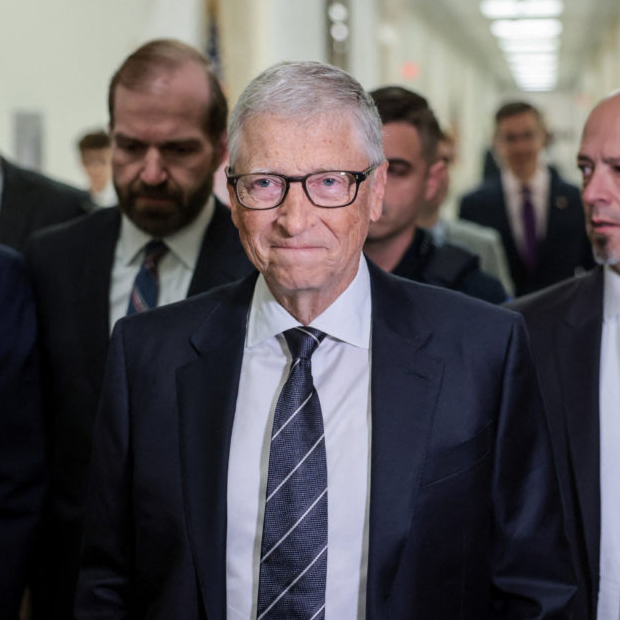
Photo Credit: Getty Images
Bill Gates has warned that artificial intelligence could transform nearly every part of working life, leaving society to decide which tasks should remain in human hands and whether some people may choose to limit their use of technology.
Speaking on The Verge's Decoder podcast with host Nilay Patel, the Microsoft co-founder said the transition to an AI-driven economy could be turbulent, even if the technology eventually makes goods and services more widely available.
"My big concern is this 20-year transition period, where they'll have winners and losers and a lot of disruption," Gates said. "And we have to get through that in order to get to that period of abundance."
His comments came as Microsoft announced a voluntary exit programme for eligible employees, with reports from CNBC, Yahoo Finance and the Financial Times indicating that about 60,000 workers could be affected. The programme is part of the company's wider efforts to manage costs as it invests heavily in AI infrastructure.
Gates believes AI could eventually take over much of the work people currently do, from growing food and building houses to performing surgery. He has also warned that the technology presents serious risks that cannot be left entirely to the companies developing it.
"Once you have multiple competitors, the level of responsibility can't be with the companies. It's completely obvious," he said, arguing that governments must take responsibility for regulating AI.
He cautioned that the technology could be misused to cause serious harm, including enabling bioterrorism, even as it offers opportunities to improve medicine, education and other fields.
But Gates also raised the possibility that people may deliberately choose not to embrace every technological advance. He pointed to the Amish, whose communities limit the use of certain modern technologies, as an example of a different approach. "We're going to have real choices. We have had groups — not large groups, but like the Amish — who don't live at the technology frontier," he said.
In another part of the discussion, Gates suggested that childcare, food preparation, art and sports could remain human activities even if AI becomes better at performing them.
He has previously identified coding, biology, energy work and professional sports as areas likely to retain a role for people. Gates has argued that humans may still want to play and watch sports themselves, rather than leave everything to machines.
The central question, he suggested, will be whether efficiency should determine every decision about how technology is used.
"I hate being the bearer of concerning news on this, but it's even worse not to tell people that this is coming," Gates said. "We have choices as humans to make about how we shape it."