

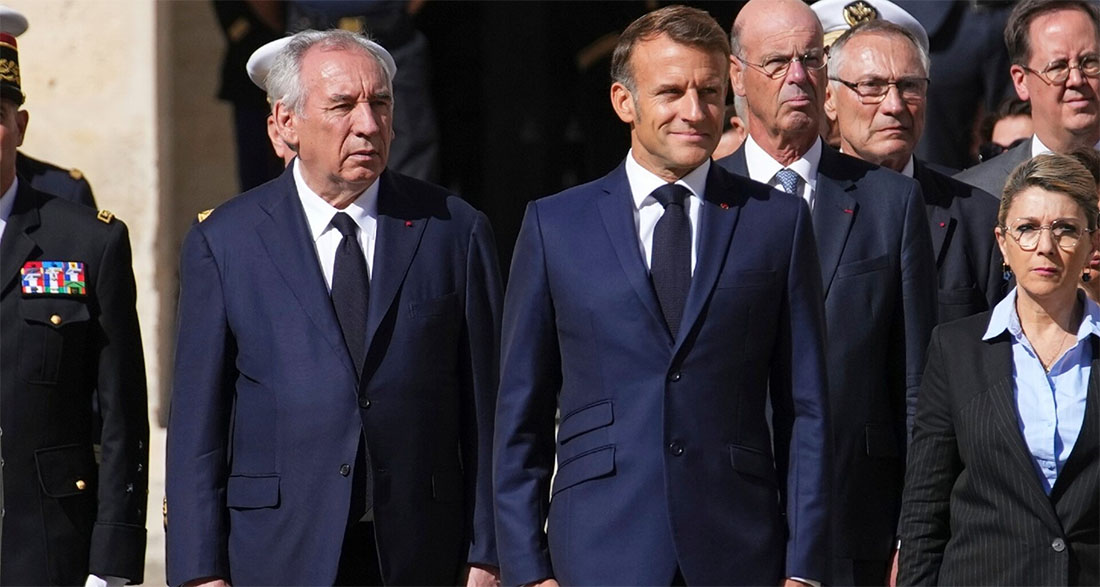
Photo Credit: Getty Images
France was plunged into fresh political turmoil on Monday after lawmakers voted to oust Prime Minister François Bayrou, dealing a major blow to President Emmanuel Macron and leaving the country adrift in the midst of mounting fiscal and geopolitical pressures.
Bayrou, who had been in office for just nine months, lost a dramatic confidence vote after pushing a controversial €44 billion ($51 billion) savings package through parliament. The plan included scrapping two public holidays and freezing government spending — proposals that triggered anger across the political spectrum. In the end, 364 MPs voted against Bayrou, while just 194 backed him, easily surpassing the 280-vote threshold required to topple the government.
His departure mirrors that of his predecessor Michel Barnier, who was also forced out by a no-confidence vote last December. The repeated collapse of centrist-led governments underscores France’s deep political fragmentation and the difficulty Macron faces in governing with a divided parliament.
According to the Élysée Palace, Bayrou is expected to submit his resignation on Tuesday morning, after which Macron will name a new prime minister. But his options are fraught. Defense Minister Sébastien Lecornu and Justice Minister Gérald Darmanin are among the frontrunners, though the post is increasingly viewed as a poisoned chalice. Both the far right and far left have already warned they will immediately trigger another confidence vote if Macron names yet another centrist.
The crisis comes at a time of serious economic strain. Investors have reacted nervously, driving French government bond yields above those of Spain, Portugal, and even Greece — countries once at the heart of the eurozone debt crisis. Analysts warn that a possible downgrade of France’s sovereign credit rating later this week could deal another blow to its fragile financial standing.
Bayrou, addressing lawmakers before the vote, defended his austerity package as necessary to prevent the country’s debt burden from spiraling further out of control. “You have the power to bring down the government, but you do not have the power to erase reality,” he said. “Reality will remain relentless: expenses will continue to rise, and the burden of debt, already unbearable, will grow heavier and more costly.” He admitted that France had “broken the social contract” with younger generations by allowing public debt to pile up.
The roots of the instability trace back to Macron’s decision last year to call a snap election after the far-right National Rally surged in the 2024 European Parliament elections. That gamble backfired, leaving France with a fractured parliament in which Macron’s centrist bloc lost significant ground to both the far right and far left. The stalemate has paralyzed policymaking and left successive prime ministers unable to govern effectively.
Looking ahead, the political deadlock shows no sign of easing. The Socialists are demanding higher taxes on the wealthy and a reversal of Macron’s business-friendly tax cuts — measures strongly opposed by the conservative Les Republicains, whose support is crucial in any coalition. Meanwhile, Marine Le Pen’s National Rally is riding high in the polls, with a recent Elabe survey suggesting it would come first if fresh elections were called. Macron, however, has so far resisted calls to dissolve parliament, fearing such a move would only strengthen his opponents.
Public anger is building. The far left has called nationwide protests under the slogan “Bloquons tout” (“Let’s block everything”), beginning Wednesday, while major trade unions plan another mass mobilization on September 18. Analysts warn that widespread unrest could echo the disruptive Yellow Vest movement of recent years.
The crisis could not come at a worse time internationally. With wars raging in Ukraine and the Middle East, France’s instability risks undermining Europe’s unity and resolve. Observers note that both Russian President Vladimir Putin and former U.S. President Donald Trump have seized on France’s political dysfunction as proof of Europe’s weakness.
As Macron scrambles to appoint yet another prime minister, the larger question looms: can France find a path out of its fiscal and political paralysis, or is the stage being set for a historic shift in power toward the far right?