

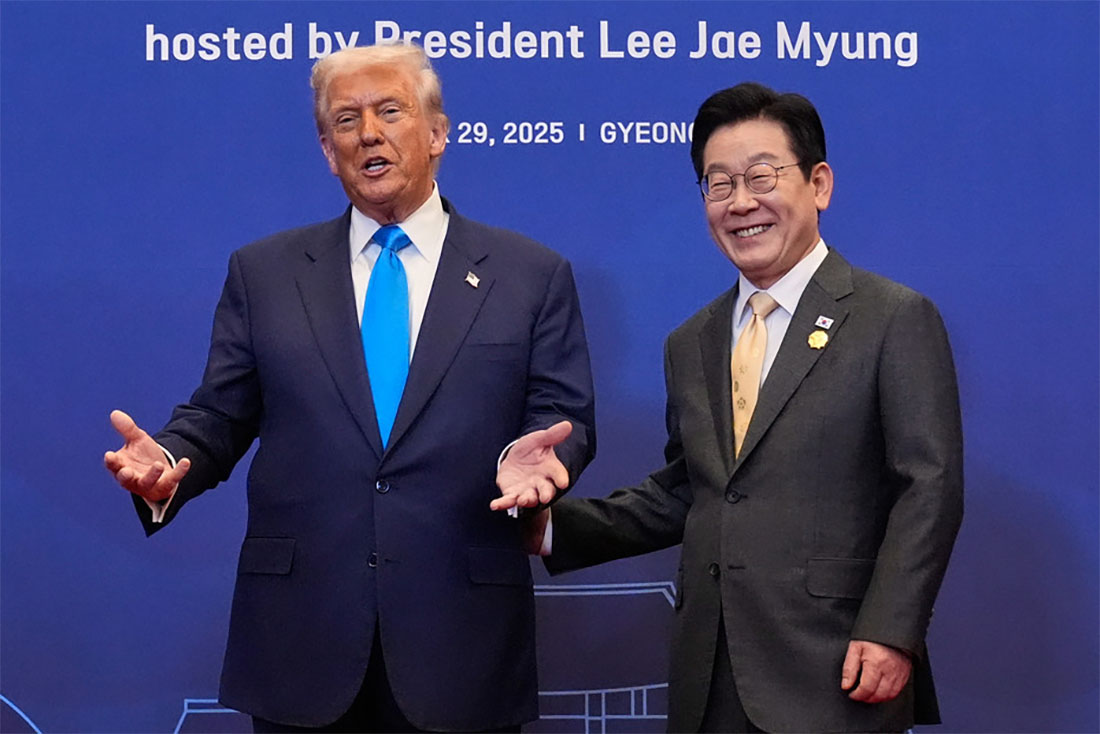
Photo Credit: Getty Images
President Donald Trump has announced that the United States and South Korea have “pretty much finalized” a major trade agreement, marking a key milestone in his ongoing Asia tour even as the U.S. grapples with the growing fallout of a government shutdown now stretching into its 29th day.
The announcement came after Trump’s bilateral meeting with South Korean President Lee Jae Myung at the Gyeongju National Museum on Wednesday. According to South Korean presidential chief of staff for policy Kim Yong-beom, both nations agreed on the final details of the long-discussed deal that had previously stalled over auto tariffs and investment terms.
Under the agreement, tariffs on South Korean automobile exports to the U.S. will drop to 15%, aligning with Japan’s rate, while semiconductor tariffs will be adjusted to match competitive standards with Taiwan. Additionally, South Korea committed to a $350 billion investment package—$200 billion in cash and $150 billion in shipbuilding cooperation—spread over several years. Kim emphasized that limiting the annual investment to $20 billion would stabilize South Korea’s foreign exchange market, a key concern during negotiations.
The deal, Trump said, represents “a tremendous meeting” and “a big win for American workers,” while also strengthening economic ties between Washington and Seoul. The finalized framework follows months of talks since July, when both countries agreed on a broad trade outline but struggled to settle on specific tariff reductions and investment terms.
The visit also came with moments of pomp and spectacle. South Korea feted Trump with its highest honor—a golden crown—and treated him to a gold-themed dessert, while a military band played “YMCA,” the Village People anthem that has become synonymous with Trump’s political rallies.
However, the U.S. president’s foreign policy victories are overshadowed by the widening crisis at home. The federal government shutdown, triggered by an ongoing funding standoff between Republicans and Democrats, continues to send shockwaves across the country.
Millions of Americans risk losing access to the Supplemental Nutrition Assistance Program (SNAP) after the U.S. Department of Agriculture announced it lacks the funds to pay $8 billion in food stamp benefits for November. House staffers are also set to miss their paychecks for the first time, while air traffic controllers, unpaid for nearly a month, warn of lasting disruptions to the aviation system.
Meanwhile, the Trump administration announced an end to the automatic extension of immigrants’ work permits—a move expected to leave thousands temporarily unemployed as their renewal applications face processing delays.
As Trump heads into a high-stakes meeting with Chinese President Xi Jinping, global attention now turns to whether his administration can balance its foreign policy ambitions with a deepening domestic crisis. The Xi-Trump meeting, analysts say, could shape the next phase of global trade relations—yet back home, millions of Americans remain caught in the political deadlock that shows no sign of breaking.