

Photo Credit: Getty Images
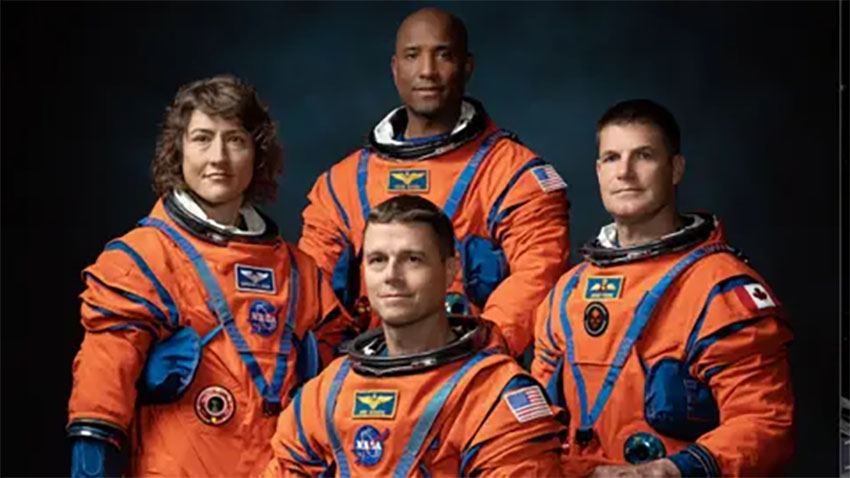
For the first time in more than 50 years, NASA is preparing to send astronauts back to the Moon. The Artemis II mission, scheduled for launch as early as February 2026, will fly a crew of four around the lunar surface in a historic journey that echoes the Apollo missions of the 1960s and 70s—while opening the door to humanity’s future on other worlds.
Commander Reid Wiseman summed up the crew’s excitement at a recent press conference: “We’re going to the Moon… it’s going to be amazing! We’ll see things no human has ever seen.” He explained that their spacecraft may pass over vast areas of the Moon untouched by previous missions, offering unprecedented views and opportunities for exploration.
The Artemis programme aims not only to return astronauts to the Moon, but also to establish a long-term presence there as a stepping stone toward Mars. For Wiseman and his team, their spacecraft’s chosen name—Integrity—captures the mission’s spirit: “Peace and hope for all humankind… when you squeeze it all down, it will create magic.”
Mission specialist Christina Koch will make history as the first woman to travel to the Moon. Inspired by the iconic “Earthrise” photograph taken by Apollo 8 astronaut Bill Anders in 1968, Koch grew up with a poster of that image on her wall. She hopes her own mission will inspire a new generation just as Apollo inspired the world during a turbulent time.
Koch is no stranger to breaking records—she spent 328 consecutive days aboard the International Space Station in 2019, the longest single spaceflight by a woman, and participated in the first all-female spacewalk. An engineer and adventurer, she brings both experience and passion to Artemis II.
Canadian astronaut Jeremy Hansen will be making his first trip into space and will also become the first non-American to travel to the Moon. A former fighter pilot and physicist, Hansen has already made his mark as the first Canadian to lead astronaut training at NASA’s Johnson Space Center.
Echoing the Apollo 8 crew who inspired him, Hansen says Artemis II comes at another challenging moment in history: “When they flew around the Moon just before Christmas in 1968, the world was struggling. People said, ‘You saved 1968.’ I think we can all resonate with that today.”
Pilot Victor Glover, known for his charisma and energy, will be the first Black astronaut to journey to the Moon. He previously flew to the International Space Station on NASA’s SpaceX Crew-1 mission. With three master’s degrees and a fighter pilot background, his colleagues know him by his call sign, IKE—short for “I Know Everything.”
For Glover, the Artemis mission reflects humanity’s deepest instincts: “Pushing ourselves to explore is core to who we are. It’s in our nature. We go out to learn where we are, why we are, and to answer the big questions about our place in the universe.”
Commander Reid Wiseman is a veteran of the International Space Station, where he spent six months in 2014. Despite his leadership role, he credits the drive and humility of his crew: “They want to do this mission. They are keenly driven, humble to a fault. It’s so cool to be around them.”
A widowed father, Wiseman describes parenthood as his greatest challenge and reward. His perspective grounds the mission in humanity as much as science and exploration.
The Artemis II astronauts speak with the same sense of ambition that once fueled Apollo. Their words carry echoes of Neil Armstrong’s “giant leap for mankind” and President Kennedy’s call to take on challenges “because they are hard.”
Each crew member brings a powerful message:
Koch: “We are ready.”
Hansen: “We are going.”
Glover: “To the Moon.”
Wiseman: “For all humanity!”
As the world watches, Artemis II is poised to mark not just a return to the Moon, but the beginning of a new chapter in exploration—one driven by unity, diversity, and the shared dream of reaching farther than ever before.