

Photo Credit: Getty Images
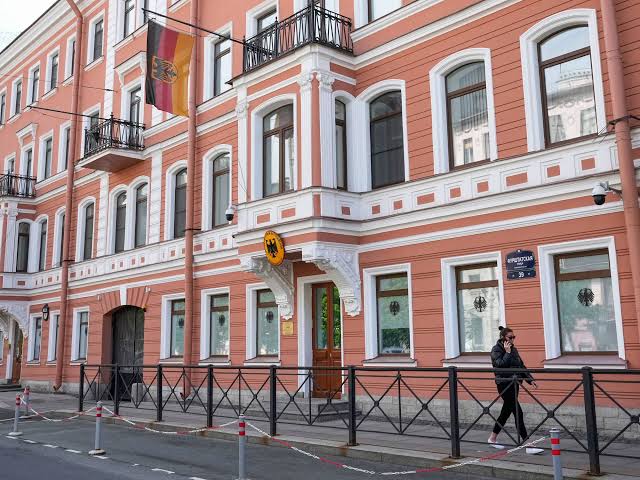
Russia has ordered the closure of German cultural centres on its territory and revoked permission for Germany’s consulate in St. Petersburg to operate, retaliating against measures taken by Berlin amid escalating tensions over an attempted drone attack at Leipzig/Halle Airport.
Russian Foreign Minister Sergey Lavrov said German Goethe-Institut cultural centres in Moscow, St. Petersburg and Yekaterinburg would be closed after Germany ordered the closure of the Russian Consulate General in Bonn and terminated the lease of the Russian House of Science and Culture in Berlin. Moscow said the Goethe cultural centres must cease operations by September 13, with their staff required to leave Russia by the same date.
Russia also revoked its consent for the German Consulate General in St. Petersburg to operate, ordering the diplomatic mission to wind down by September 18 and its employees to leave the country by that date. Lavrov said any failure by Moscow to respond to Berlin’s measures would demonstrate a lack of “self-respect.”
Speaking at an economic forum in Vladivostok, he said Germany “could not have failed to understand” that closing the Russian cultural centre in Berlin would “signify the end of their cultural presence in Russia.” Russia’s Foreign Ministry accused Berlin of having “provoked a new escalation in bilateral relations.”
The dispute intensified after Germany blamed Russia for an attempted drone attack at Leipzig/Halle Airport on August 4. An explosives-laden drone was discovered near a Ukrainian aircraft at the airport, a major international freight hub used in providing support to Ukraine. The device was later defused.
Russia has denied responsibility. Russian President Vladimir Putin accused German authorities of attempting to distract attention from domestic political problems and dissatisfaction among voters. He also claimed that evidence presented against Moscow “has been planted.”
The United Kingdom, European Union and NATO condemned the Leipzig/Halle Airport incident, while European Commission President Ursula von der Leyen described it as an attempt targeting cargo aircraft. Western governments have repeatedly accused Moscow of carrying out sabotage, cyberattacks, disinformation and other disruptive activities across Europe to undermine support for Ukraine. Russia denies conducting such a campaign.
Germany has said it has become a “daily target” of what it describes as the Kremlin’s hybrid campaign. The tensions have spread beyond Germany. Poland, Denmark, Finland, the United Kingdom, the Czech Republic and Lithuania have summoned Russian diplomats following Germany’s accusations.
In Munich, several incendiary devices were thrown at a construction site near a building housing several companies, including businesses operating in the defence sector. The Bavarian State Criminal Police Office said a brief fire caused no significant damage and that investigators suspected one of the companies in the area may have been the intended target.
Two Bulgarian nationals were arrested, although police had not confirmed their suspected involvement. Separately, Norwegian authorities seized a Russian vessel in the Arctic archipelago of Svalbard at the request of Ukraine’s state-owned Naftogaz energy company.
A Norwegian court ordered the seizure as part of Naftogaz’s efforts to recover a $4.22 billion arbitration award arising from Russia’s 2014 annexation of Crimea and seizure of Ukrainian energy assets, including gas fields and pipelines. Moscow refused to pay the 2023 award, prompting Naftogaz to seek the seizure of Russian commercial assets through national courts.
Putin described the vessel seizure as “state terrorism,” while Russia’s Foreign Ministry summoned Norwegian Ambassador Heidi Olufsen to protest the decision. Moscow said the vessel belonged to Russia’s state weather and environmental monitoring agency and had been transporting workers, scientists and cargo to Russian settlements in Svalbard. Russia said it “will seek to lift the vessel’s arrest.”
In Finland, more than 2,000 people participated on Thursday in what was described as Europe’s largest civil defence exercise since the end of World War II. Scenarios considered during the exercise included possible missile strikes from neighbouring Russia. European Union ministers have also discussed possible responses to the attempted Leipzig drone attack as the bloc considers how to counter suspected hybrid operations without resorting to military action.
The EU has imposed almost two dozen sanctions packages on Russia over its war against Ukraine, targeting more than 3,000 officials, oligarchs and entities, including banks, energy companies and drone manufacturers. EU Counter-Terrorism Coordinator Bartjan Wegter suggested that some of the bloc’s existing counter-terrorism mechanisms could potentially be used against individuals linked to such activities.
“If we list individuals as terrorists, we can deploy a range of instruments to actually target those individuals and to track them, all their activities and people associated with those individuals,” Wegter said. He said measures designed to combat terrorist financing and money laundering, as well as efforts to strengthen critical infrastructure such as airports, could also be relevant.