

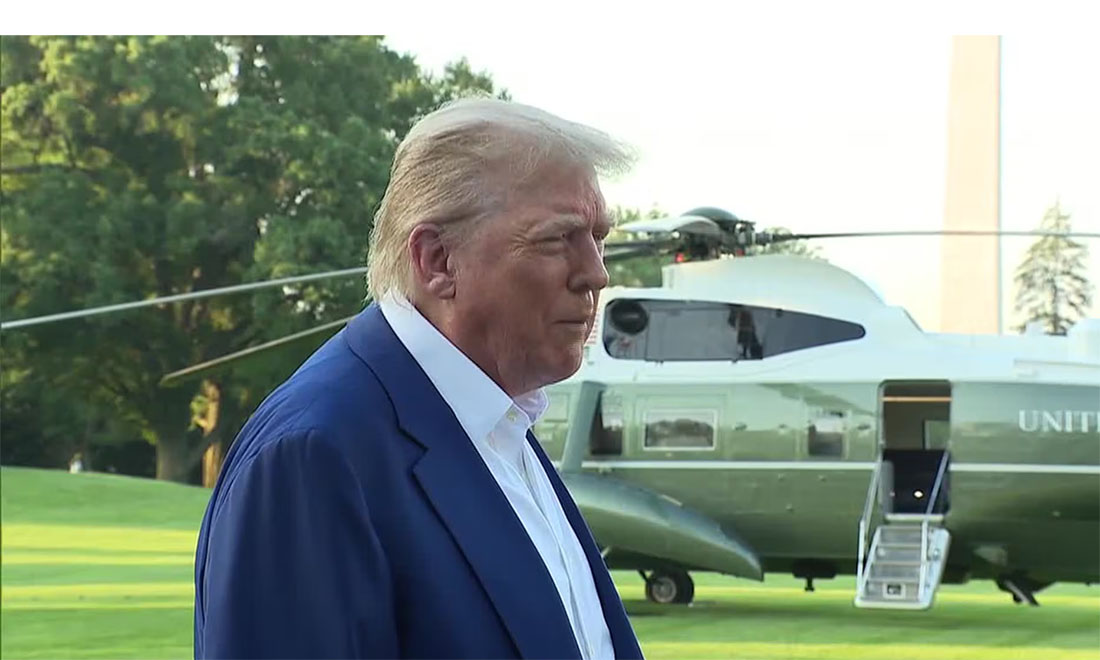
Photo Credit: Getty Images
US President Donald Trump has signed an executive order directing the United States government to recognise Lake Ontario as "Lake America," adding a new and unusual dimension to the escalating trade dispute between Washington and Ottawa.
Trump announced the move on Thursday, saying the name change would take effect immediately. The order directs the US Department of the Interior to update the Geographic Names Information System, the federal system used to standardise geographic names for official US purposes.
The decision comes shortly after trade negotiations between the United States and Canada collapsed. Washington has imposed new 50 percent tariffs on approximately $20 billion worth of Canadian goods, while Canada has announced plans for equivalent counter tariffs.
Trump had repeatedly raised the possibility of renaming the lake on social media before formally signing the order.
Lake Ontario is one of the five Great Lakes and forms part of the international boundary between the United States and Canada. It borders New York State on its southern side and the Canadian province of Ontario to the north.
Canadian officials have rejected the proposed name. Prime Minister Mark Carney pointed to the long history of the name Lake Ontario, noting that it predates both the Canadian Confederation and the creation of the United States.
Carney said Canadians would continue to call the body of water Lake Ontario.
The disagreement echoes Trump's earlier decision to rename the Gulf of Mexico as the Gulf of America in 2025. That change also generated opposition from Mexico, which argued that the United States could not unilaterally rename a shared body of water.
The Lake Ontario dispute raises similar questions about the limits of national authority over geographic names. While the US president can direct federal agencies to use a particular name within the American government, the order cannot compel Canada or international organisations to adopt it.
The lake's name has deep historical roots. The name Ontario comes from an Indigenous term associated with the Huron people and predates European settlement. The Canadian province of Ontario subsequently took its name from the lake.
There is also no single international organisation with universal authority over the names of international bodies of water. This means the United States can establish its preferred terminology for domestic governmental use, while other countries remain free to use their own names.
The decision has therefore become more than a question of geography. Coming amid deteriorating relations between the two neighbouring countries, it has become another visible symbol of the growing tension between Washington and Ottawa.
For Canadians, the message from officials has been straightforward: the lake remains Lake Ontario.
For the US government, however, federal documents and geographic databases will now be directed to use a different name.
Whether the rest of the world follows remains another matter entirely.